| |
Appreciation
Soraya, a Singer Who Needed No
Translation
By Achy Obejas
Special to The Washington Post
Friday, May 12, 2006
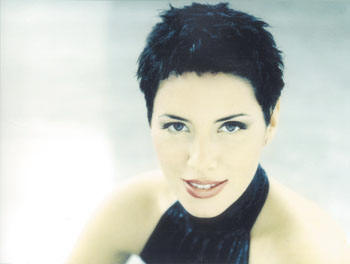
Soraya, the Colombian American pop star, walked anxiously in circles,
wanting the magazine photo shoot to be over. It was December 2004, and the
session was part of a carefully staged comeback after the
singer-songwriter's four-year bout with breast cancer. Ringlets of gel-stiff
brown hair framed Soraya's face and sweat threatened to stain her sleeveless
white top, which showed off both her buffed arms and the generous curve of
her bosom.
The message of that cover photo: This is one sexy, but tough, woman.
"I have so many things to do," she said, less with annoyance than sadness.
"This is taking up an entire day of my life. Every hour, every minute
counts. They don't know that yet," she said, looking toward the photo staff,
"but I do."
She seemed to know how numbered her days really were. Back then, Soraya was
being publicly hailed as a breast cancer survivor and the album about to be
released, "El Otro Lado de Mi," was her testament. On Wednesday, at 37, she
died of breast cancer in Miami, where she'd lived most of her adult life.
Soraya Lamilla, the American daughter of Lebanese immigrants to Colombia,
worked not to be stuck in any category or stereotype. She sang and wrote
flawlessly in Spanish and English. Intensity and intelligence were part of
her sex appeal.
By age 31, when her cancer was diagnosed, she had already scored No. 1 hits
all over Latin America and Europe. She had sold out shows worldwide, worked
with Rod Argent, written songs with Carole King, opened for Sting, Michael
Bolton, Natalie Merchant and Zucchero, and recorded duets with Japanese
multimedia artist Ryuichi Sakamoto, German popster Erkan Aki and Arab
superstar Andy.
She was doing a self-exam in the shower when something "didn't seem quite
right," as she later recalled. She was acutely aware of the disease. Her
aunt, grandmother and mother had all died of breast cancer. The title song
of her first album, 1996's "En Esta Noche/On Nights Like This," was a
tribute to her mother's struggle.
She had Stage 3 cancer. "I'd already read the literature, I already knew the
options," she said. Radiation, chemotherapy, a double mastectomy and breast
reconstruction followed. Suddenly her life seemed to be completely taken up
with survival. She became a spokeswoman for the Susan G. Komen Breast Cancer
Foundation and traveled the country doing outreach.
Almost lost was the fact that Soraya had accomplished what almost no artist
before her had: simultaneous careers in English and Spanish markets, with
the same material -- almost all of it self-composed.
While most Latino artists with non-Latino fans work the Latin market and
then cross over (think Ricky Martin, Marc Anthony) or focus on
English-language careers with little effort toward the Latino market
(Jennifer Lopez, Cypress Hill), Soraya's first two albums were released in
separate Spanish and English versions, featuring the same songs, with lyrics
that respected not only the same themes, but frequently the same images and
metaphors. On later albums, she laid songs in Spanish next to English ones,
but never mixed the two languages.
"It really isn't something I think about," said Soraya. "The songs come out
in whatever language they come out. I don't really have a method. I'll stop
doing this when I have a method. Of course, I have the musical knowledge and
I pay attention to syntax and to meter and all that."
She crafted sophisticated lyrics about love -- and later, about survival,
about finding a true spiritual path -- set to rock, folk and Latin rhythms.
She also sneaked in Middle Eastern modalities. She was a trained classical
violinist and laughed about how she played "technically incorrect chords" on
guitar, the instrument for which she was best known in her pop career.
Soraya was born in Point Pleasant, N.J., but spent her early years traveling
to and from Cali, Colombia, her family's home town. Her earliest musical
influences included Colombian folk and pop, as well as American artists such
as Carole King and Fleetwood Mac.
English was forbidden in her family home, where her mother insisted that
Spanish be honored and that Latin American and Lebanese cuisine be
preserved.
Soraya graduated from Rutgers University with a degree in English literature
and French philosophy. She was working as a flight attendant and playing
coffeehouses and clubs around campus when her demo tape, featuring almost
all the songs that would be on "En Esta Noche/On Nights Like This," made its
way to executives at Polygram/Island, who promptly signed her. Success
followed success, even after the cancer diagnosis. Her fourth album and the
first after her illness, "Soraya," received the 2004 Latin Grammy in the
singer-songwriter category -- no small feat, since she was up against Latin
music legends Juan Gabriel, Joan Sebastian and Joan Manuel Serrat.
Her last album, "El Otro Lado de Mi," was released last year and took a
number of honors, including a Latin Grammy nomination. The album was darker,
more urgent, marked by an intense focus on social justice. It was as if she
were trying to get everything out, one final time.
On Monday, the final posting on Soraya's Web site included this epilogue: "I
lived my dream, and today I can't ask for anything else."
Link to Story
|
|